
Defying Gravity
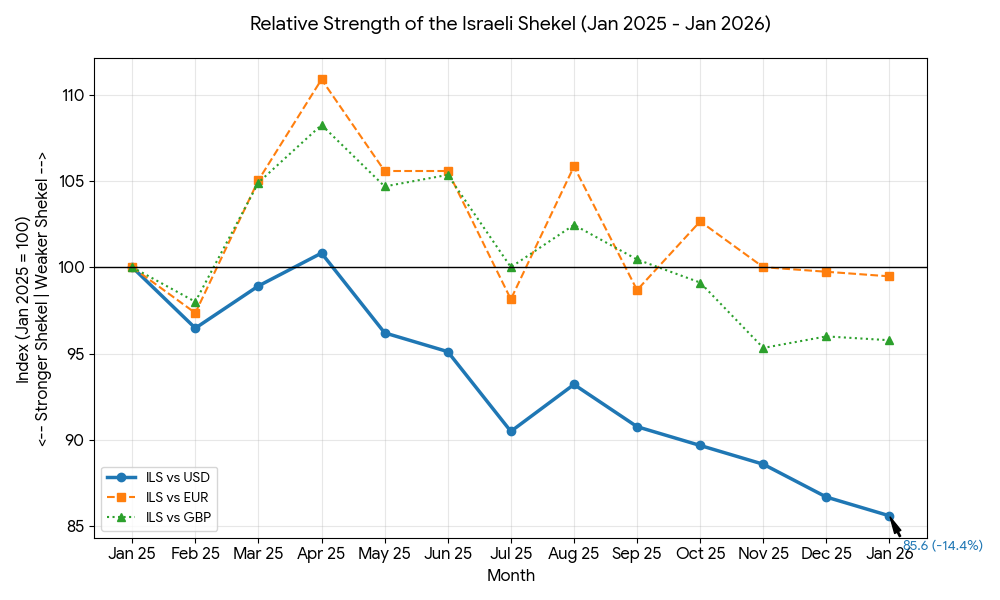
The Israeli shekel entered 2026 as one of the world's most resilient currencies. It still hovers around four-year highs despite of everything. Why?

Having spent this past Shabbat visiting friends in Jerusalem, I had the opportunity to interact with even more American ex-pats than I normally encounter around Ra’anana.
And while there is plenty to be worried about here in Mr. Bibi’s neighborhood, talk kept coming back to how worthless their dollars have become for those whose income is in greenbacks and outgo is in shekels.
When those ex-pats shut down their phones ahead of the holy sabbath, that rate was approaching 3.13. At this writing, USD/ILS is 3.1615.
So, despite two years of war and domestic upheaval, the local currency has appreciated more than 14% over the past 15 months. Why, indeed?
Structural Shift
From what I’ve been able to uncover, the rally isn’t just about a “weak dollar” narrative. It is being driven by a structual shift in Israel’s economic fundamentals.
Where to begin?
Clearly, the startups that make up the Startup Nation remain the primary engine of shekel demand. The surge in high-value high-tech acquisitions over the last 18 months have triggered massive inflows of foreign capital, primarily of US dollars.
When acquirers like Google, ServiceNow and Nvidia buy Israeli startups, they typically convert billions of dollars into shekels in order to pay local employees, founders and taxes.
Meanwhile, local institutional investors, mainly pension funds, that have benefitted from increases in the Nasdaq 100 and other global tech indexes have been forced to sell dollars and buy shekels to maintain their currency exposure limits.
Commodity Currency
At the same time, while cyber security startups grab all of the headlines, exports from our offshore gas production are fueling the evolution of the shekel into a commodity currency, including December’s landmark $35 billion gas deal to supply Egypt through 2040.
Expanded production from the Leviathan and Tamar offshore fields ensures a steady-stream of dollar-denominated royalties and taxes, much of which is poured into the sovereign wealth fund, and bolstering the country’s long-term balance of payments.
Collapsing Risk Premiums
The third leg of the shekel’s strength is the collapse of the risk premium, as financial markets price in a post-war dividend.
As ceasefire agreements in Lebanon and Gaza stablized over the second half of 2025, Israel’s credit default swaps, essentially the cost to insure burgeoning government debt against default, falling to approximately 72 points. This allowed the Ministry of Finance to issue international bonds at much tighter spreads.
S&P Global Ratings revised Israel’s outlook to “Stable” from “Negative” in late 2025, citing military de-escalation and a ceasefire that lowered immediate security risks.
With the reduction in geopolitical risk, international bond and equity investors poured back into Israel investments.
Central Bank Discipline
Finally, we’ve been blessed with a long-line of smart, disciplined central bankers. Say what you will about our prime minister, he seems to know not to muck around here.
While other central banks have been quick to cut rates, Governor Amir Yaron and company have maintained a relatively cautious stance. Even this month’s benchmark interest rate decision, the first cut in nearly two years, to 4% from 4.5%, positions the shekel as attractive for carry trades compared to currencies where rates are falling faster.
The Bank of Israel is watching just how much gravity the shekel can defy, with any further break toward the 3.00 level likely to increase pressure for direct intervention.
To be sure, it seems like the days of USD/ILS at 3.80 are long gone, so all of you ex-pats need to plan accordingly.